Loomstack

LoomLedger

Books built for weaving, not adapted to it.

Sale bills and purchase bills, challans with and without rates, cheques that are not money until they clear, yarn and grey-cloth stock, job work with ITC-04, GSTR-1, 3B and 9, a trial balance that is forced to tie. Everything a Surat mill files, and the things it never had a place for.

  • Every GST return, from the same rows as the register
  • Beams, yarn issues, rolls and designs — the mill’s own objects
  • Production posts itself from the looms, or is typed

Generic accounting software knows about invoices and ledgers. It does not know that a challan goes out with no rate because the price is settled at billing, that a cheque received is not money in the bank, that 100 kg of yarn comes back from sizing as 96 kg of beam and 4 kg of waste, or that a job worker’s beams are not your stock. LoomLedger does, and it refuses to pretend otherwise.

A tax invoice, the way the statute wants it

Type a line. Watch the tax decide itself.

Place of supply decides whether the tax splits into CGST and SGST or goes as IGST. Rounding happens per line and once more on the total, in the order the rule says, so the half-tax on ₹1,000.10 at 5% never comes out a paise over. The amount in words is in lakh and crore, because that is how the figure is read out. Change the state, change a rate, add a line.

Interactive — try it
TAX INVOICEStar TextilesGSTIN 24AAAAA0000A1Z5 · Surat
INV-042710 Oct 2026
ItemHSNQty (m)Rate / mGST %₹

In words:

The same arithmetic LoomLedger runs. The HSN summary on the printed invoice groups by code and rate, and the triplicate copies are marked.

A cheque is not money in the bank

The float, kept honest.

A cheque clears on a date nobody controls. Between the day it changes hands and the day it clears, the money is neither with the customer nor in the bank. Most software posts it to the bank on day one, and the bank ledger is then wrong by the float at every reconciliation — so nobody reconciles. LoomLedger posts a receipt to “cheques in hand”; clearing is a second entry; a bounce mirrors the original line by line and re-opens the invoice. Walk a cheque through its life.

Interactive — try it

AccountDrCr

Four events, four different postings. Bank reconciliation then becomes arithmetic over the cheque register.

Together with LoomWatch

Yarn variance, in kilograms and in rupees.

LoomLedger knows the yarn issued to each beam. LoomWatch knows the picks woven and the pick density, so it knows the yarn that went into cloth. Set the month’s figures and the yarn rate. The difference is what a count in the godown would find — if anybody counted.

Interactive — try it
—Unaccounted
—of issued
—at the yarn rate
—a year, at this rate
The one number neither product can produce alone. Each half is a measurement; only the subtraction is new.

Statutory

Every return, read off the register.

GSTR-1

By invoice and by rate, with the HSN summary. Opening bills are left out.

GSTR-3B

With a cross-check against the GST ledgers, so a journal posted straight to a tax account shows up before the notice does.

GSTR-9

Twelve 3Bs added up and reconciled against the audited books — the week of work, laid out.

GSTR-2B reconciliation

Paste the portal’s download. Matched on GSTIN and invoice number, never on amount — the amount mismatch is the finding. Unclaimed credit is listed by name.

ITC-04

Job-work challans out and back, with the 180-day clock, only for the legs where you are the principal.

TDS and TCS

What you deducted (26Q, by section) and what was deducted from you, kept apart because they are different returns. TCS under 206C(1H), credited as a liability, never as sales.

E-invoice and e-way ready

Tax invoices carry the fields the portal asks for; the GST invoice has its own renderer because it is a statutory form, not a table.

Audit trail

Every posting, who made it, when, and what it replaced. A posted voucher is immutable; a correction is a new entry.

The mill’s own objects

Beams, yarn, rolls, designs — not “items”.

Warp beams

Prepared with ends, count and sizing cost; mounted on a loom; the cloth woven off them and the sizing loss against the construction.

Yarn issues

Warp and weft, split, to a beam or a loom, with a consumption standard per quality — and a variance verdict only where you set a tolerance.

Grey-fabric rolls

A roll entry is a cloth inspection: grade, defects, the folder’s words, the loom. The label carries a Code 128 barcode drawn by the software itself.

Taka stock

How many metres of A-grade poplin are on the shelf — the question a mill answers before promising a delivery.

Design profitability

Cost per design from what it consumed, against what it sold for. Blank, not −100%, when a design was woven this month and sold next.

Delivery promise board

Which loom serves which order line between which dates, and whether Tuesday is going to happen — at the last 14 days’ rate, not the lifetime average.

Physical counts

The store-keeper types the count, not the difference. A line that agrees writes nothing and is not an error; a shortage goes to its own account, never hidden inside consumption.

Purchase orders and quotations

An order is a promise and moves no stock. Receipts match the order line, not the item. A quotation expires on its own date and keeps itself when accepted.

Bill entry

Keyboard first. Masters created without leaving the bill.

Enter moves to the next field, including an empty one. A supplier who does not exist yet is offered as the last row of the dropdown; a small dialog asks only what the bill cannot wait for, and the new party is selected when it closes. A yarn bill for a new supplier no longer means abandoning the bill, finding the supplier screen and coming back.
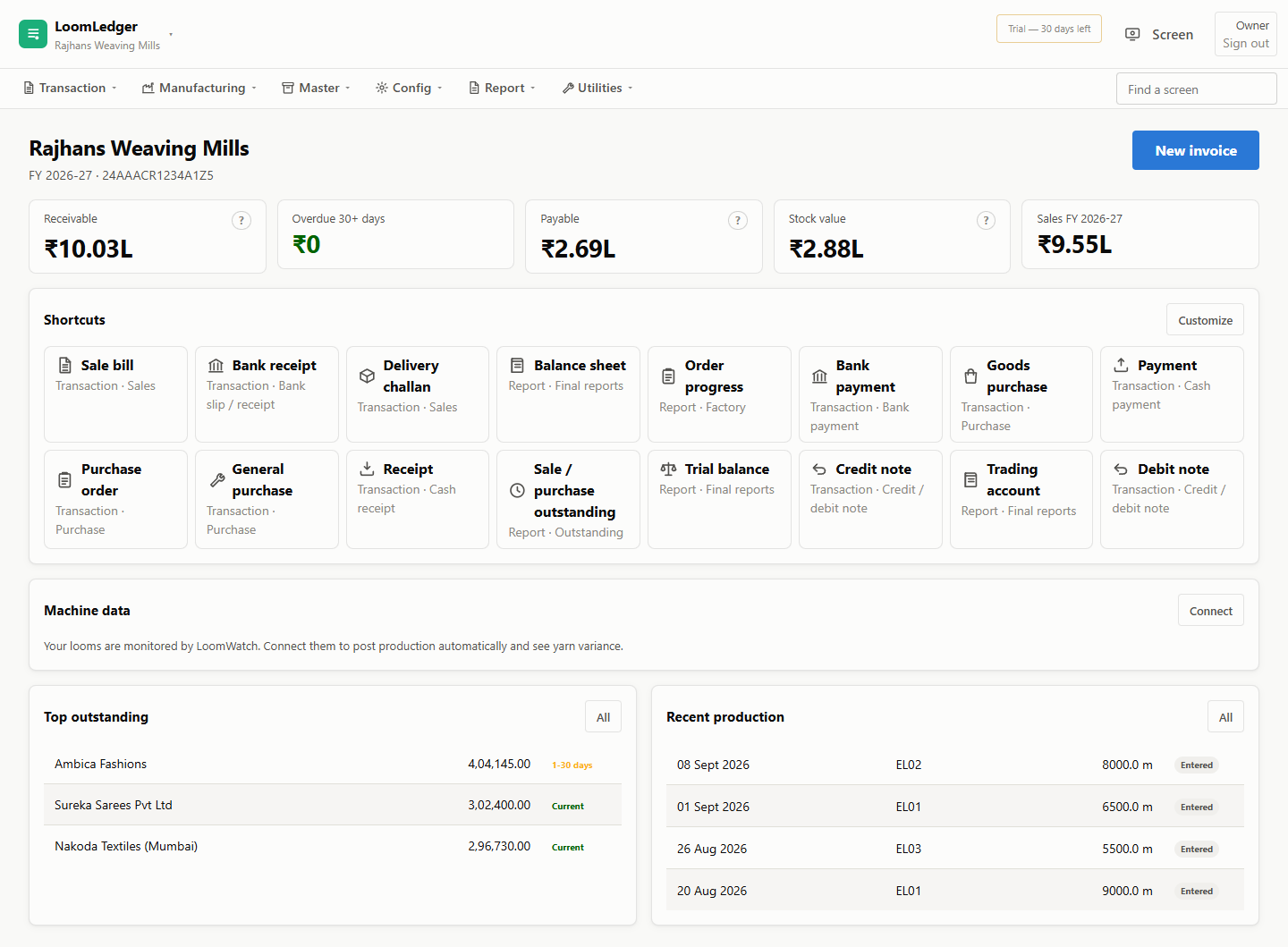
A company set up with its full chart of accounts, ready to bill.

Everything in LoomLedger

The real menu of the product, group by group.

This is the software’s own menu, not a wish list. Every entry opens a screen that exists today.

Transaction · Sales14
  • Sale billTax invoice
  • Sale register
  • Sale return / credit noteCloth back, or a rate difference
  • Delivery challanGoods out, bill later
  • Challan returnSome of it came back before billing
  • Total base challanOne agreed amount, no line rates
  • Total base challan return
  • Challan report
  • Pending challansOut and not yet billed
  • Order
  • QuotationCommits nobody, and expires
  • Gate passWhat left, and what is still out
  • LR entryThe transporter lorry receipt
  • Job workChallans in and out, and ITC-04
Transaction · Purchase11
  • Goods purchaseYarn or stores bill
  • Purchase register
  • Purchase return / debit noteGoods back, or a rate difference
  • Purchase challanGoods received, bill awaited
  • Challan return
  • General purchasePower, sizing, repairs — a bill with no item on it
  • Total base challan
  • Challan report
  • Received, not billedWhat GRNI is carrying
  • Purchase order
  • Mill job / out jobBeams out for sizing or weaving
Transaction · Cash receipt3
  • ReceiptCash in, matched to bills
  • Auto cash receiptA lump sum spread over the oldest bills
  • Receipt register
Transaction · Bank slip / receipt5
  • Cheque receiptHeld, then banked, then cleared
  • Bank receiptNEFT, RTGS, UPI
  • Cheques in hand
  • Returned cheques
  • Reports
Transaction · Cash payment3
  • PaymentCash out, matched to bills
  • Auto cash payment
  • Payment register
Transaction · Bank payment6
  • Cheque paymentIssued, then presented, then cleared
  • Bank payment
  • Cheque return
  • Passing reportWritten and not yet passed by the bank
  • Reports
  • Cash / bank transferContra: no party moves
Transaction · Journal voucher3
  • One to oneOne debit, one credit
  • Multiple JV
  • Journal register
Transaction · Credit / debit note3
  • Credit note
  • Debit note
  • Note register
Transaction · Opening entries10
  • Opening balancesThe trial balance as the books open
  • Opening balance report
  • Opening inventoryThe godown on day one
  • Opening sale bill
  • Opening purchase bill
  • Opening general purchase
  • Opening credit note
  • Opening debit note
  • Advance receipt / paymentMoney with no bill against it yet
  • Uncleared cheque entryOutstanding when the books opened; posts nothing
Transaction · Pending adjustment4
  • Pending receiptsMoney in, not yet matched to a bill
  • Pending payments
  • Pending return adjustmentCredit notes naming no invoice
  • Skipped in outstandingBills the mill has decided not to chase
Transaction · POS1
  • Counter saleBill and money in one action
Manufacturing · Production receive5
  • Production entryMetres off each loom, by shift
  • Taka stock reportRolls by quality, grade and godown
  • Taka mistakesWhat the folder marked down, worst first
  • Roll entry & inspectionA roll entry IS the cloth inspection
  • Machine masterThe office register. The monitored floor lives in LoomWatch
Manufacturing · Beam4
  • Beam entryPrepare a beam, then mount it from its card
  • Beam registerYield, yarn per metre and the sizing loss
  • Beam cardOpen a beam on the register for its whole story
  • Beam receive / issue (job)Beams sent out for sizing, and beams received to weave
Manufacturing · Job & inventory3
  • Job work challan
  • Still out at a job workerBeams and yarn somebody else is holding
  • ITC-04
Manufacturing · Consumption6
  • Define consumptionHow much yarn a metre of a quality should take
  • Item
  • Item + design
  • Item + design + colour
  • Item + lot no
  • Stock journalA physical count, a transfer, wastage
Manufacturing · Stock5
  • Stock on hand
  • By godown
  • By lot
  • Below reorder level
  • Yarn reconciliationIssued against what the looms consumed — a different question from the standard
Manufacturing · Stock entry6
  • Physical countWhat the shelf holds. The one entry that outranks the book
  • Godown transfer
  • Wastage
  • Other issue
  • Stock journal register
  • Opening stock
Manufacturing · Planning3
  • Orders & deliveryWill we make Tuesday
  • Design profitability
  • Machine data & mapping
Manufacturing · Salary (LoomCrew)5
  • Staff cost in the books
  • Karigar masterPeople, rates and roles
  • Day book & attendancePresence, machines and hours
  • Advances (upad)
  • Wage sheet
Master · Trade5
  • PartiesCustomers, suppliers, agents, transporters
  • Items & stock
  • Yarn
  • Grey fabric
  • Stores & spares
Master · Factory2
  • Looms
  • Employees
Master · Books2
  • Opening balancesThe chart of accounts, and what each one opened with
  • Company
Config · Documents3
  • Bill formatThe wording on each printed document
  • Email formatThe words per document, with placeholders
  • Whatsapp message formatSame templates, the WhatsApp channel
Config · Profiles2
  • Email profileThe mill’s own mail host
  • SMS profileThe gateway the mill pays for
Config · Year3
  • Summary processIs there anything left undone
  • Transfer / create new yearClose the year and carry the balances forward
  • Opening entriesWhere a new installation begins
Config · Data import4
  • Import itemsYarn, fabric and stores from a CSV
  • Import accountsParties and ledgers
  • Import transactionsPlain journals — tax and stock belong in the editors
  • Import takaInspected rolls onto the shelf
Config · Setup3
  • Advance setupThe company, its GST and its books dates
  • User configurationWho signs in, kept once for the suite
  • Audit clientsThe auditors, and the period each was given
Config · System4
  • BackupWhat is backed up and where it goes
  • Restore from backupThe one command that brings it back
  • Check for updateWhat is running here
  • Zap databaseRemove the transactions, keep the masters
Report · Day book register6
  • Sale / purchase detailsEvery tax document, date by date, with the split
  • Account detailsOne account, opening to closing
  • Cash book
  • Bank book
  • Bank reconciliationWhat the statement should say, and why it does not
  • Day bookEvery voucher, as entered
Report · Final reports6
  • Trial balance
  • Trading accountDown to gross profit
  • Profit & loss account
  • Balance sheet
  • Opening + transactions + balanceSix columns per account
  • Account wise balanceOne line per account
Report · Outstanding5
  • Sale / purchase outstandingBill by bill
  • Ageing outstandingBy party, by bucket
  • Brokerage statementWhat each agent earned, and is owed
  • Bill versus paymentHow long each bill actually took to be paid
  • Interest report, bill wiseOnly where a rate was agreed
Report · GST10
  • GSTR-1
  • GSTR-3B
  • GSTR-3B monthly summaryTwelve months on one screen
  • GSTR-2 (inward supplies)
  • GSTR-2B reconciliationInput credit the portal has and the books do not
  • GST registers
  • Credit / debit note report
  • GSTR-9 (annual)
  • GST refundAccumulated credit on zero-rated supplies
  • ITC-04 (job work)
Report · Tax deducted2
  • TDS reportWhat we deducted, and what was deducted from us
  • TCS report
Report · Journals from a report3
  • Interest report (account J.V.)Charge the interest, bill by bill
  • Depreciation report (J.V.)Per asset, pro-rated by days held
  • Fixed asset register
Report · Documents10
  • Sale register
  • Purchase register
  • General purchase register
  • Receipt & payment register
  • Cheque register
  • Challan report
  • Pending challans
  • Quotations
  • Gate passes
  • LR register
Report · Factory5
  • Production
  • Quality by machine
  • Design profitability
  • Order progress
  • Yarn reconciliationIssued against what the looms consumed
Report · Trail2
  • Audit trailWho changed what, and when
  • Account zoomA year of one account by month, then drill in
Utilities · Control2
  • Data freezeNo posting into a filed period
  • Summary processIs there anything left undone
Utilities · Find2
  • Transaction searchOne box over every dated document
  • Query toolA read-only question, capped at 500 rows
Utilities · Tax1
  • Tax separate resetRe-derive the tax the bills carry
Utilities · Data import1
  • ImportItems, accounts, transactions and taka from a CSV
Utilities · Setup3
  • Company
  • Opening entries
  • Machine data & mapping
Utilities · People1
  • Employee cost

Put the books on the same screen as the looms.

LoomLedger stands alone for a mill with no monitoring — production is typed, and lands as the same row. With LoomWatch, it arrives by itself.