A loom stops and you hear at day-end
By the time the round reaches it an hour of cloth is gone, and nobody can say which machine, or why, or how long.
Loomstack tells you which machine stopped and why, the moment it happens. It keeps GST-ready books from the cloth your looms actually wove, pays each weaver for the machines they actually ran, and finds work for the looms standing idle. Nothing in it is ever guessed.
The way it is today
Eighteen looms, two shifts, a master, a muneem, a WhatsApp group and a diary. Every number that matters is in somebody’s head or on somebody’s page, and by the time it reaches the owner it is a day old and slightly wrong.
By the time the round reaches it an hour of cloth is gone, and nobody can say which machine, or why, or how long.
A weaver runs four machines one day and seven the next. Adding it up at month-end from eighteen books is guesswork nobody can check.
Bills in one diary, payments in another, the accountant chasing both. The return goes late and the figures never quite tie.
What was issued and what the looms used live in two different worlds. A 5% loss on ₹30 lakh of yarn a month is ₹1.5 lakh that nobody sees go.
The suite
Each one is worth buying alone. Owning the next one does not add features — it changes where the numbers come from. What used to be typed arrives by itself.
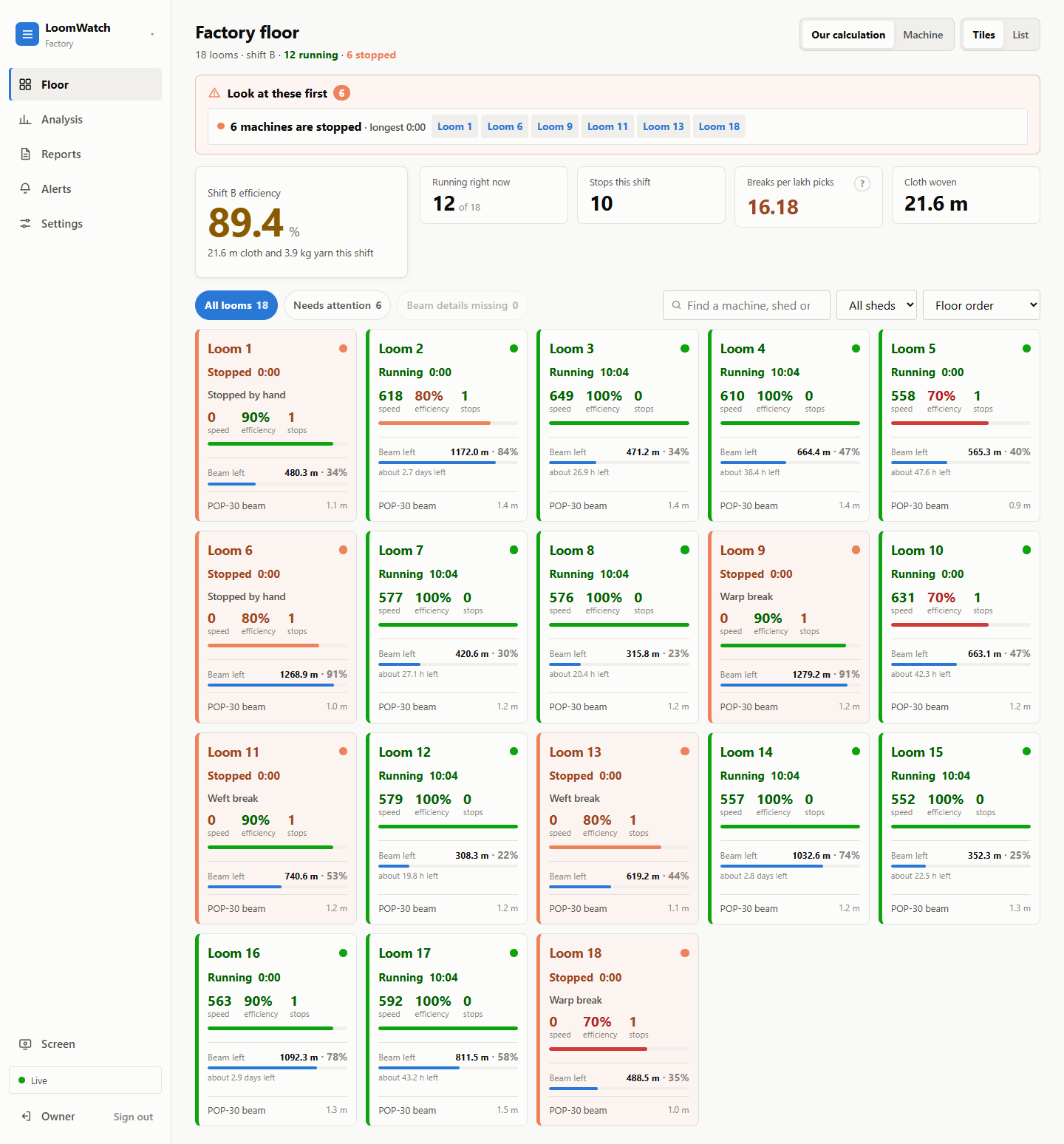
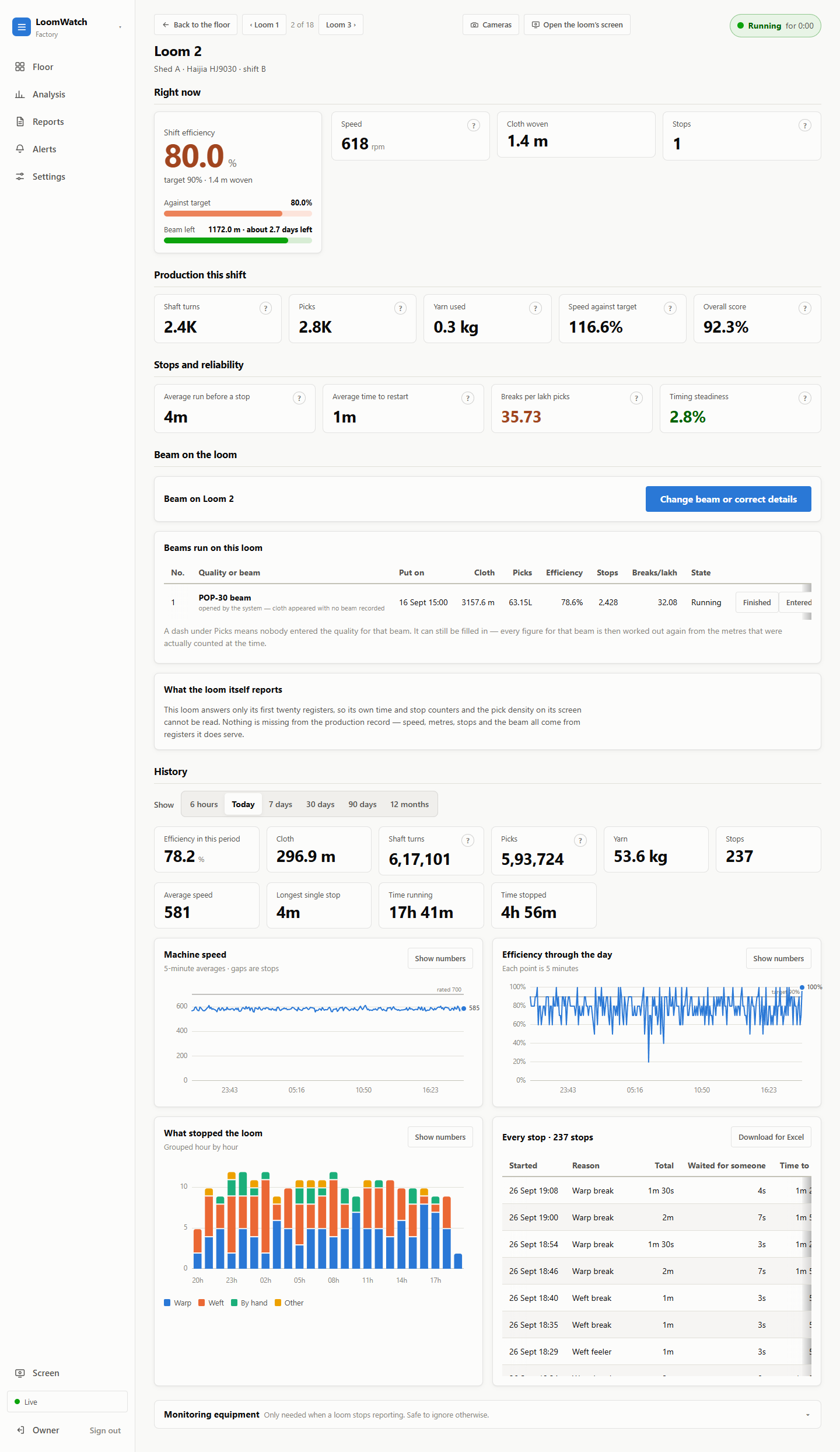
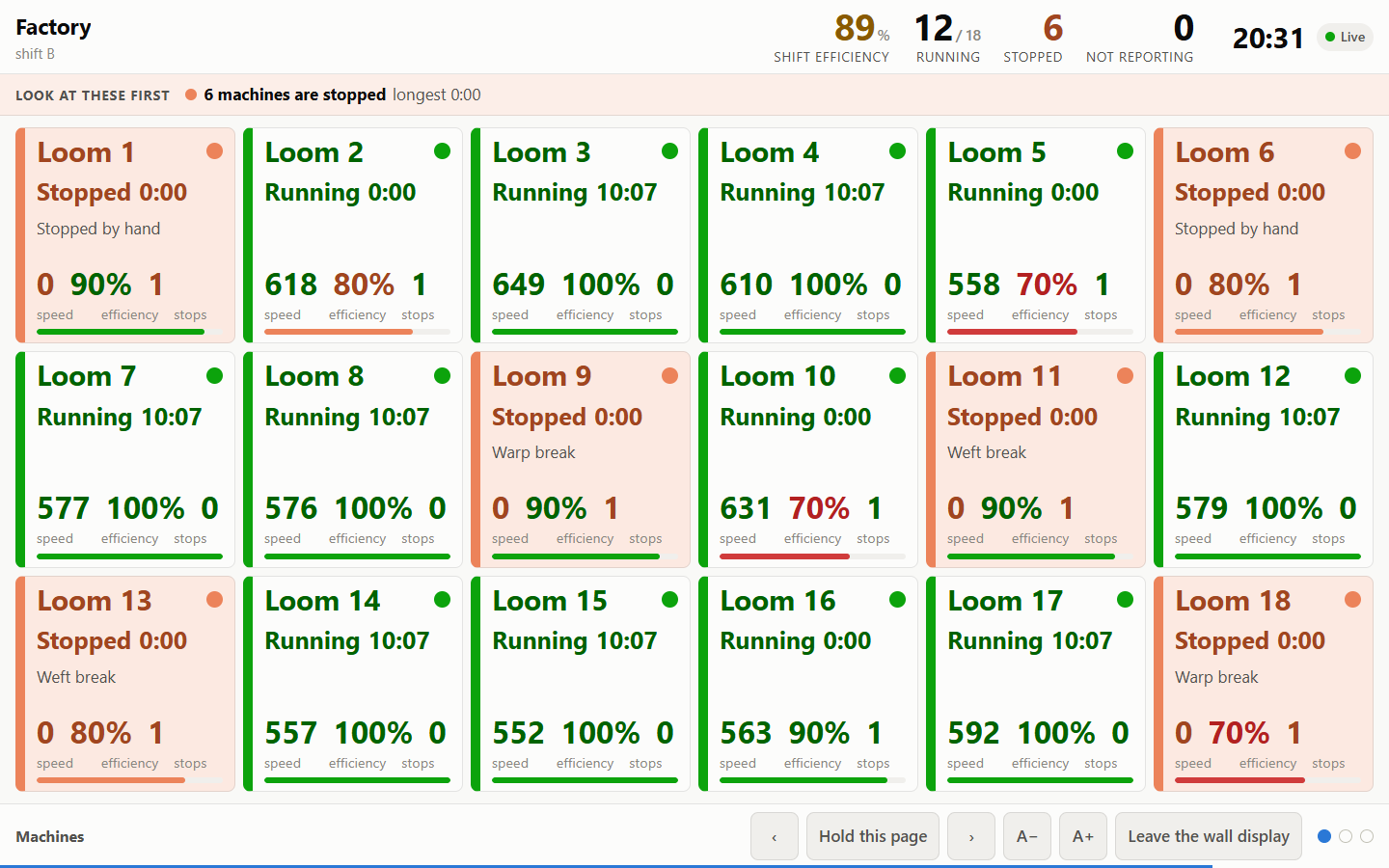
Every machine in real time — running, stopped, and exactly why. Beam run-out before it runs out. Alerts on WhatsApp. A board for the office wall.
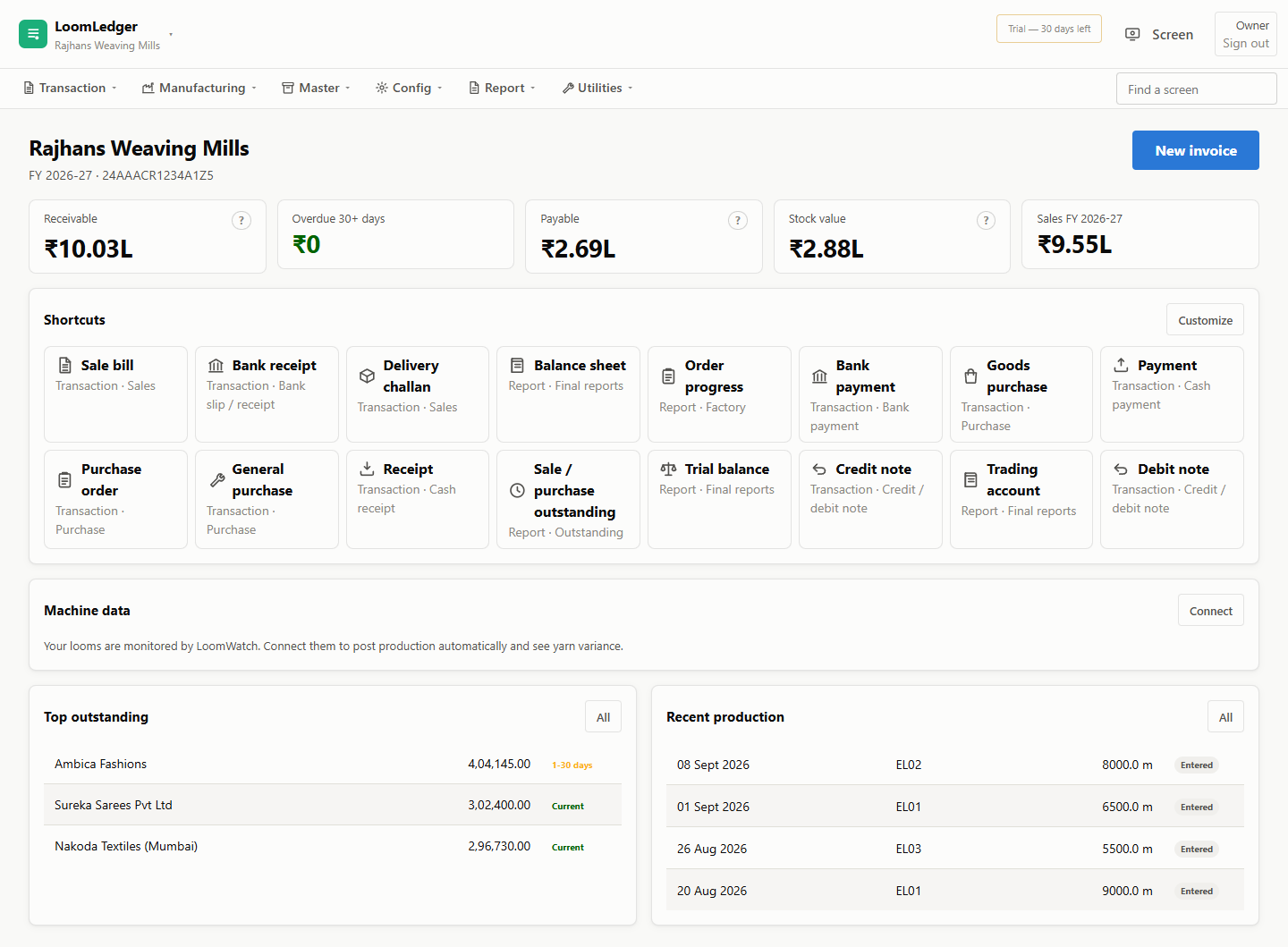
Read the full story 02Sale and purchase bills, challans, cheques, stock, job work with ITC-04, every GST return, double-entry books — built for a weaving mill, not adapted to one.
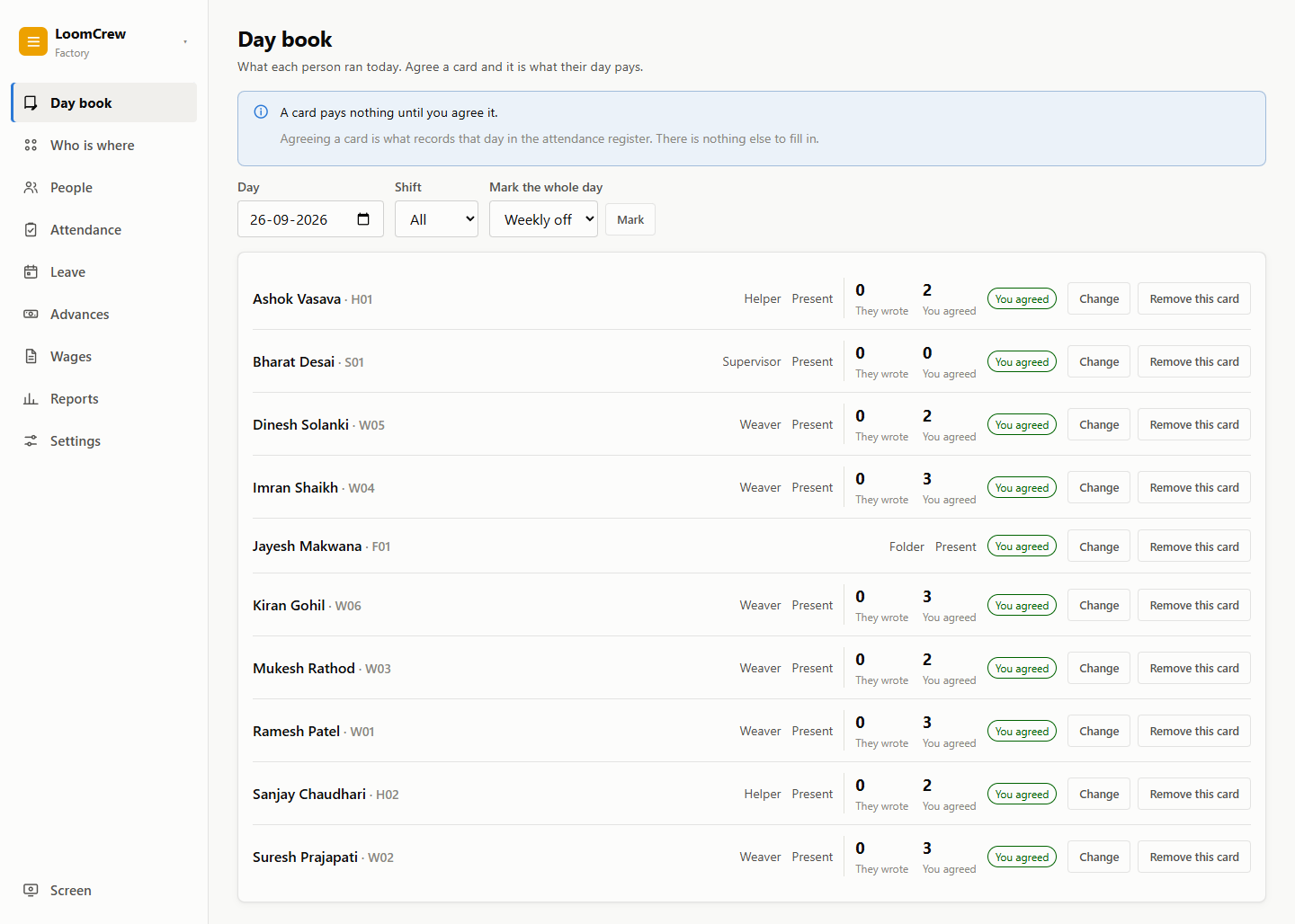
Read the full story 03A day card per worker per shift. Machine, slab, piece and daily pay rules. Attendance, leave, advances. Nothing pays until the owner agrees the card.
Read the full story 04Mills with more orders than looms list the work; mills with idle looms take it on. Verified factories, measured efficiency, settled on WhatsApp.
Read the full storyThe number only the combination can produce
LoomLedger knows what left the godown. LoomWatch knows what went into cloth — pick by pick, from the loom’s own counters and the beam’s pick density. The difference is the figure every mill owner suspects and nobody can see, because the two halves of the subtraction have always lived in different books.
A rule we do not break
Most software fills a blank with a plausible number. A loom nobody has described gets a “typical” pick density, and the picks, yarn weight and efficiency built on it look exactly like measurements. We checked such a figure against a live floor once: it was 8% wrong on one loom and 40% wrong on another, at the same moment, with nothing to show it. So Loomstack never assumes a fabric detail, a wage rate, a challan rate, an interest rate or a count. An unknown stays a dash until somebody enters it, and everything built on it stays a dash too.
“A mill cannot tell a fabricated figure from a real one. So we never fabricate one.”
The real screens
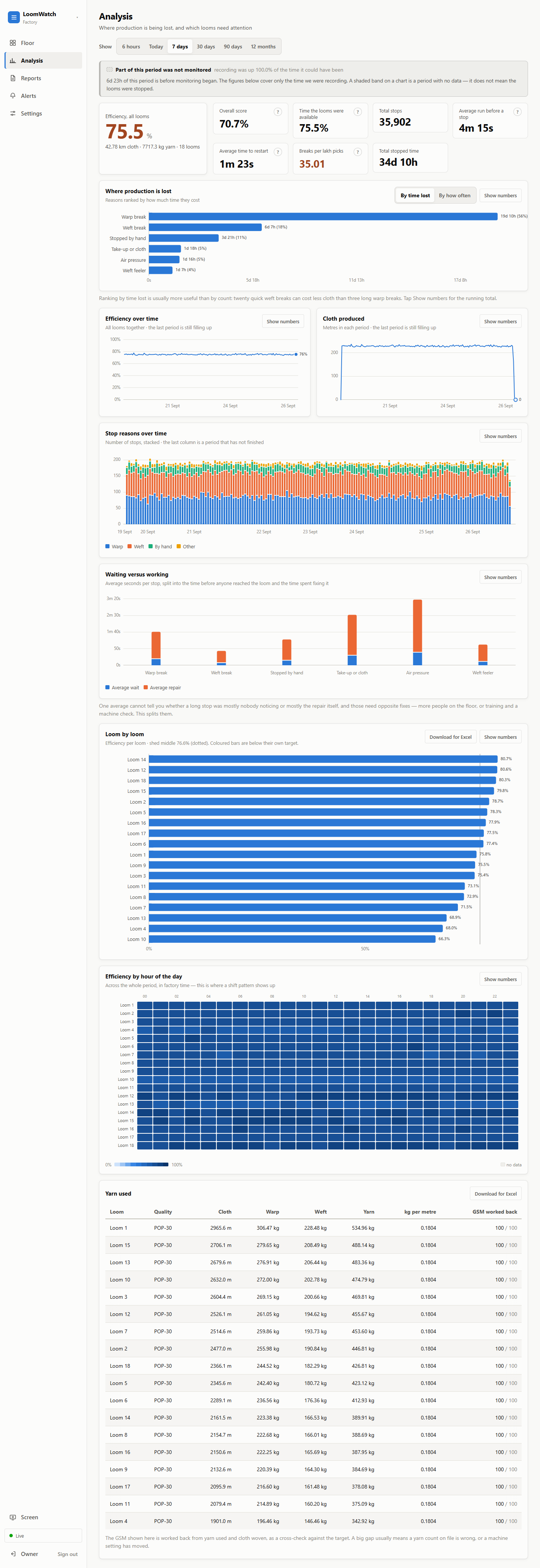
Running on a demo mill, in the language you pick. Nothing is a mock-up.
Where it runs
Open it on any phone or PC. We keep it updated, backed up nightly and watched. Each factory is its own database and its own process — a cross-factory query is not possible, by construction.
The exact same software on a PC in the mill. One file plus PostgreSQL. Your data never leaves the building, and the installer does the rest.
A small box on your network reads the looms and buffers through an outage. When the line is back, every reading arrives. A dropped connection never loses a shift.
Tell us how many looms you run. We will show Loomstack working with your looms, your qualities and your language — no pressure, no lock-in.